Automotive & EV Parts
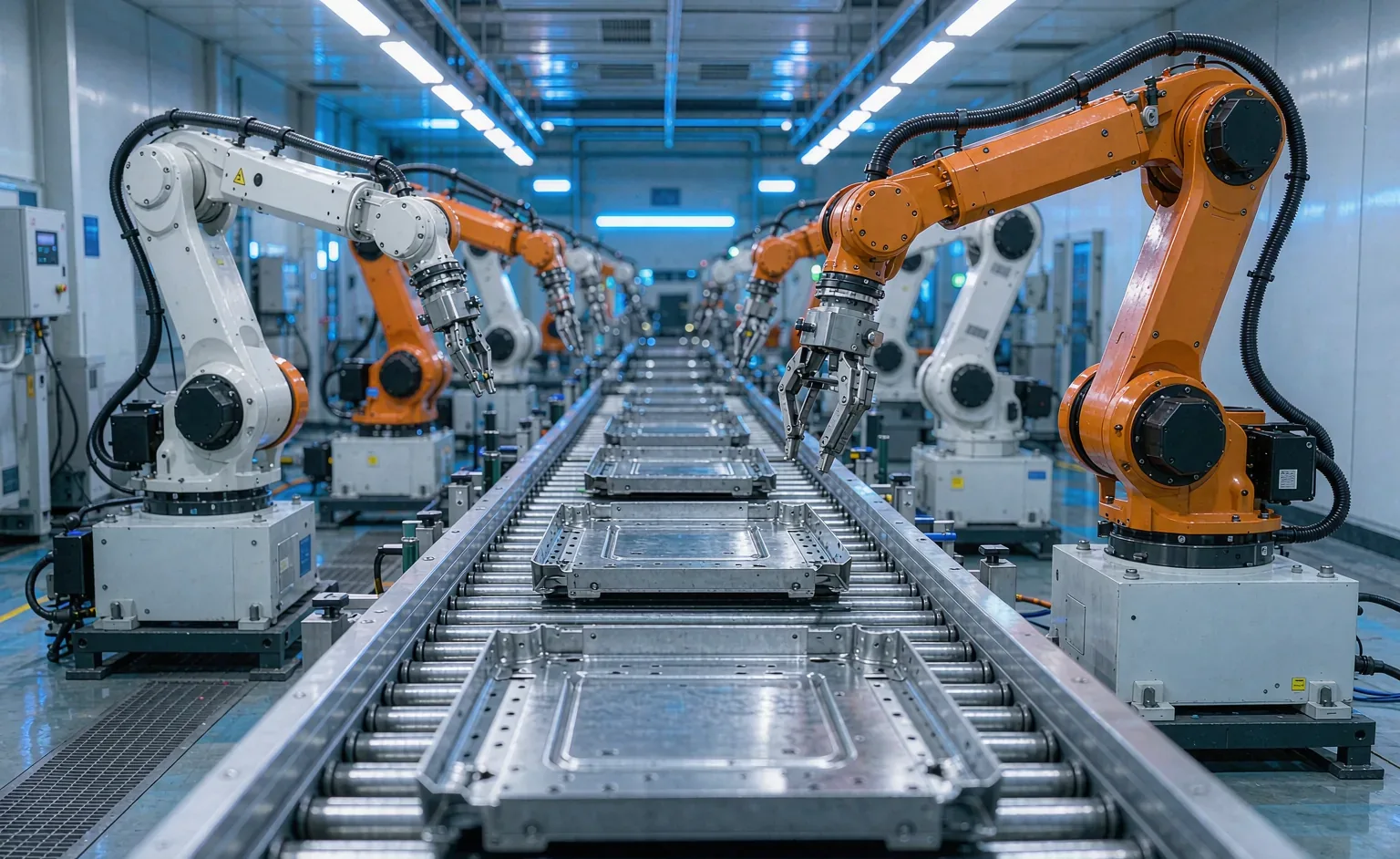
Battery trays, cooling plates, motor shields and sensor housings — automotive-grade steel and aluminium with heat-number traceability on every carton.
Three Things That Decide Whether This Part Works
We do not claim to be the cheapest metal shop in Asia. We are the one that lets you stop managing your supply chain.
Fatigue-Critical Geometry
Grain direction in aluminium and weld quality in steel decide whether a part lasts ten years. We control both explicitly rather than leaving them to chance.
Traceability That Survives Audit
Heat numbers stamped on cartons so any part traces back to its coil — and PPAP Level 3 documentation when your customer requires it.
Volume With a Stable Schedule
96.5% on-time over twelve months, and if we miss a date that is our fault, we credit it back rather than explain it.
From Prototyping to Production
The same five stages whether you order one sample or 500,000 pieces.
Prototyping
Get parts for early-stage development. We use low-cost materials and processes to make samples that behave like the final product, so your design iterations are cheap and fast.
- Rapid material and design iterations
- Detailed prototypes for complex geometry
- Models that resemble final parts
Engineering Validation
Functional prototypes that let you identify every design risk before you commit to tooling. Where needed this takes several iterations to hit the required performance metrics.
- Precision parts manufacturing
- Reliable design and engineering support
- Optimised material properties
Design Validation
Validate function, performance and appearance. This is where material and finishing choices get decided — the point where a part starts looking and feeling right.
- Parts for market and field testing
- Performance and appearance validation
- Durable, repeatable finishes
Production Validation
Prepare for full-scale production with production-grade tooling and quality control. Verify the process before you order volume.
- Low-volume production tooling
- Verification of manufacturing processes
- Functionality of production-ready parts
Volume Production
Move to end-use parts at volume. Our in-house tooling, SPC and inspection keep yield and quality high while lead times and unit costs fall.
- Tight tolerances on precision parts
- Secondary operations for surface finish
- Rigorous inspection and QC
Four In-House Processes, One Purchase Order
Every process below happens under the same roof, on the same inspection record.
Sheet Metal Fabrication
Laser and plasma cutting, CNC bending, welding and assembly for enclosures, brackets and chassis.
View productsPrecision Stamping
Single, progressive and compound dies holding ±0.05mm on flat and shallow parts at volume.
View productsDeep Drawing
Single and multi-step hollow parts up to 300mm, with wall thickness progression controlled.
View productsCNC Machining
3, 4 and 5-axis milling plus turning, reaching ±0.02mm where the geometry allows.
View productsSurface Treatment
Anodizing, powder coating, plating, passivation and 30+ finishing options done in-house.
View productsAssembly & Kitting
Mechanical, pneumatic and electrical sub-assembly, kitted and labelled to your BOM.
View productsWhat We Run This Job On
Grades chosen for this sector's environment. Tell us if yours is not here — we source to spec.
Materials
- •6061-T6 / 5052-H32 aluminium
- •SPCC / SGCC / SECC steel
- •Galvanised DX51D / S250GD
- •304 / 316L stainless
- •Copper C110 busbar
- •PA66-GF30 / PPS insulators
Surface Finishes
- •E-coating (E-coat)
- •Fluorocarbon outdoor coating
- •Hot-dip galvanising (ISO 1461)
- •Powder coating, RAL
- •Zinc-nickel plating
- •Laser marking & VIN plates
Common Automotive & EV Parts We Manufacture
If your part is not listed, send the drawing — custom work is the majority of what we do.
Questions We Get About Automotive & EV
Do you support PPAP submission?
Yes — Level 1 through 5, including control plan, PFMEA and process capability studies where the part family calls for them.
What grain direction do you target for aluminium parts?
The direction that carries your primary load. Where a stamp or draw will not preserve it, we say so in the quotation and propose a machined alternative.
We Also Manufacture For
Send Your Automotive & EV Drawing
STEP, DWG or a photo. An engineer reviews it and returns a firm price within two working hours — with a manufacturability note attached.